Revolutionary Segmented Rotor Design for Small-Diameter SynRM Motors

Higher performance, simpler manufacturing, superior efficiency - redefining what's possible in small-scale motor technology.

Breakthrough Technology

Our innovative segmented rotor design overcomes the limitations of conventional flux-barrier designs in small-diameter synchronous reluctance motors.

The Challenge

Conventional flux-barrier designs face significant constraints when applied to small-diameter motors (below 30mm):

  • Manufacturability issues with thin barriers
  • Limited space for multiple flux barriers
  • Reduced performance due to constrained geometries
  • Complex production processes for small-scale components
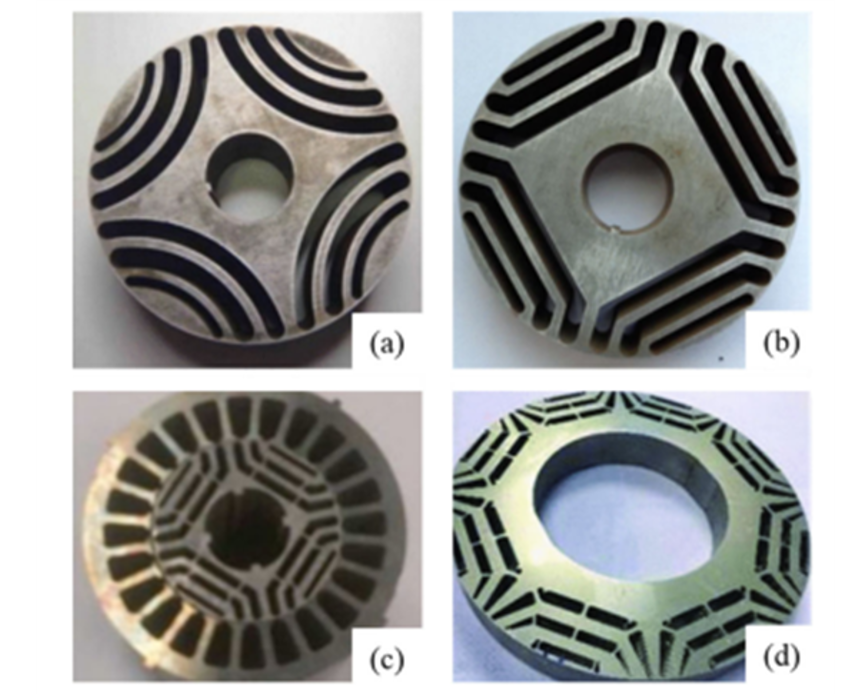
Conventional flux barrier limitations

Our Solution

The segmented rotor topology offers a fundamentally different approach:

  • Complete separation of rotor poles through modular segmentation
  • Maximized reluctance variation without internal flux barriers
  • Simplified manufacturing process
  • Superior performance characteristics despite small diameter
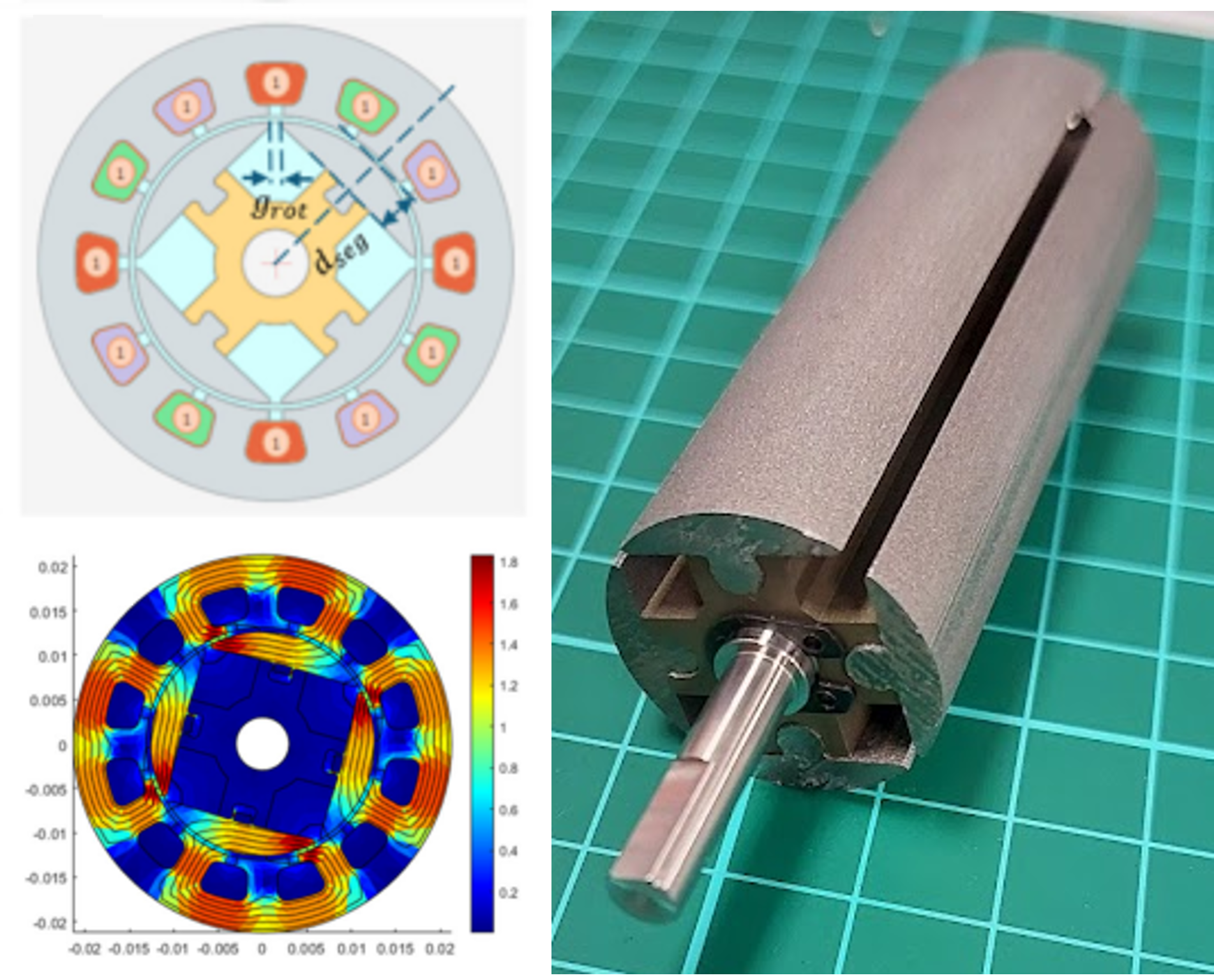
Segmented rotor solution

Key Advantages

Our segmented rotor SynRM motor delivers exceptional performance with practical production benefits.

Superior Saliency Ratio

Achieves an impressive saliency ratio of 2.07, significantly outperforming conventional designs for small-diameter applications.

Excellent Torque Density

Delivers 2.2 × 10⁻⁵ N·m/mm³ torque density, comparable to larger machines despite the miniaturization challenges.

🔧

Manufacturing Simplicity

Two-component structure simplifies production compared to complex flux-barrier designs, reducing costs and improving reliability.

🌡️

Thermal Performance

Enhanced thermal management characteristics with lower iron losses, enabling operation in demanding environments.

Technical Specifications

Detailed performance metrics of our segmented rotor SynRM motor.

Parameter Segmented Rotor SynRM Conventional Flux Barrier Design
Saliency Ratio (Ld/Lq) 2.07 1.44-1.80
Torque Density 2.2 × 10⁻⁵ N·m/mm³ 0.97-1.7 × 10⁻⁵ N·m/mm³
Maximum Torque (50A) 0.78 N·m 0.34-0.62 N·m
Power Factor (5000 r/min) 0.63 0.56-0.72
Efficiency (5000 r/min) 45.75% 23.72-40.27%
Rotor Diameter 25.24 mm 25.24 mm
Structure Segmented with aluminum holder Integrated flux barriers

Research Validation

Our technology is backed by rigorous research and experimental validation.

Research Partners

Universiti Malaysia Pahang al-Sultan Abdullah

Universiti Malaysia Pahang al-Sultan Abdullah

Université de Technologie de Compiègne

Université de Technologie de Compiègne

MotorXP LLC US

MotorXP LLC US

Peer-Reviewed Research

Our innovative approach has been validated through comprehensive research published in the journal of Electrical Engineering (2025). The study demonstrates that conventional flux-barrier design rules become less effective at small scales and presents our segmented rotor topology as a viable alternative.

"The segmented rotor achieves superior performance with a saliency ratio of 2.07 and torque density of 2.2 × 10⁻⁵ N·m/mm³, comparable to larger machines reported in recent literature."

Mechanical analysis confirmed structural integrity under high-speed operation, with maximum stress and deformation values well within acceptable limits. Experimental validation largely corroborated simulation results.

Segmented rotor in comparison others

Register Your Interest

Learn more about our segmented rotor SynRM technology and how it can benefit your applications.

Our Collaborators

Meet the engineers and researchers behind our innovative motor technology.

EMDLab

Dr. M. A. H. Rasid

Lead Researcher Electrical Machines, UMPSA

Expert in electrical machine design with focus on synchronous reluctance motors.

UTC

Prof. Vincent Lanfranchi

Professor, Electrical Machines, UTC

Multiphysics experts of electrical machines, specialized in machine vibroacoustics.

MotorXP

Dr. Vladimir Kuptsov

Electromagnetic Software Developer, MotorXP

Expertise in electromagnetic FE software development.